
Route three
River & Canal History
Northwest Ohio’s story runs along the Maumee River: a swamp that blocked travel, forts that guarded the frontier, a canal that opened trade and a city built on glass.
The Great Black Swamp
After the last ice age, much of the region was a flat, waterlogged forest known as the Great Black Swamp, covering roughly 1,500 square miles. It was hard to cross and slow to settle. During the 1800s it was drained with ditches and clay tile, turning it into some of the richest farmland in Ohio.
The Maumee River
The Maumee flows north-east from Fort Wayne, Indiana, to Lake Erie at Toledo. Its watershed is the largest of any river flowing into the Great Lakes. Every spring, usually in March and April, walleye swim upriver to spawn, and anglers line the banks and wade the shallow rapids.
Forts and the War of 1812
Fort Meigs, on the Maumee at today’s Perrysburg, was built in 1813 and held through two sieges by British and allied forces during the War of 1812. The reconstructed fort is now a historic site and museum. Nearby, the Fallen Timbers battlefield recalls the 1794 battle that shaped the frontier.
The Toledo War
In 1835 and 1836, Ohio and Michigan argued over a strip of land that included Toledo. The dispute was mostly bluster, with very little fighting. Ohio kept Toledo, and Michigan received the Upper Peninsula when it became a state.
The canal era
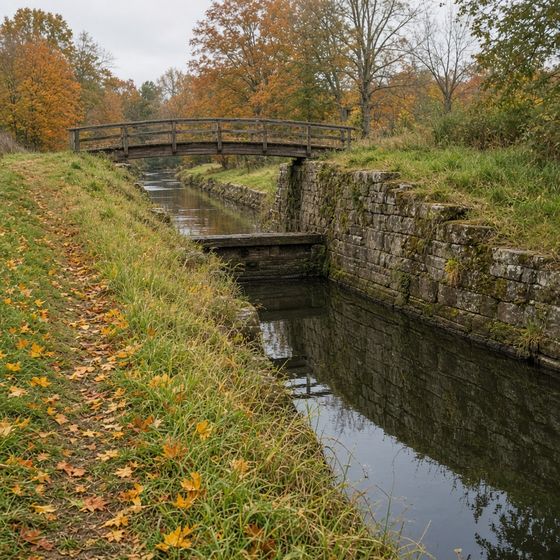
The Miami and Erie Canal was completed in 1845, linking Cincinnati and the Ohio River with Toledo and Lake Erie. Canal boats were pulled by mules walking along the towpath. Some locks and sections survive, and a restored canal boat still carries visitors through a working lock in the Maumee valley.
| Date | Event |
|---|---|
| 1794 | Battle of Fallen Timbers |
| 1813 | Sieges of Fort Meigs |
| 1822 | Marblehead Lighthouse first lit |
| 1835–36 | Toledo War between Ohio and Michigan |
| 1845 | Miami and Erie Canal completed |
| Late 1800s | Swamp drainage and the rise of Toledo’s glass industry |
The Glass City
Cheap natural gas and good sand helped make Toledo a centre of glass manufacturing from the late 1800s. Bottles, windows and car glass made here were sold around the world, and the city is still known as the Glass City. Its art museum is famous for its glass collection.
Visiting history well
- Check opening days before you go; many historic sites are seasonal.
- Stay on paths at battlefields and burial grounds.
- Never dig or use metal detectors at historic sites.